How to Start Investing in the Stock Market 2025
Want to increase your money and control your financial future? Learning to start investing stock market in 2025 is the first step. In this simple, no-fluff guide, you will learn how to open your first investment account, make a safe strategy, and use modern equipment to increase your wealth. Whether you are a student, full-time worker, or freelancer, the stock market is within your reach. You do not need thousands of dollars to start. In fact, many investors start using only a few rupees using apps that offer differential investment. Thanks to technology, learning to invest is now easier than ever. You can automate your portfolio, follow specialist tips, and track your performance – from your phone.
This guide will run you through every necessary step, from establishing your first account to creating a strong investment mentality. We will also cover the best platforms for beginners, to avoid common mistakes, and how to be consumed through market ups and downs. Ready to start? Let’s unlock the world of investing in the stock market – Step by Step, The Smart Way.
Why the Investing Stock Market Trend Still Counts in 2025
In 2025, the investment in the stock market is one of the most powerful and proven methods to create long-term money. Apps like Robinhood, Atoro, Webul, and Sophie have opened doors for everyday investors. Now you do not require individual brokers, financial advisors, or thousands of dollars to start. Just a smartphone and a plan. What the stock market makes has the ability to generate passive income over time. Historically, a diverse stock portfolio has improved traditional savings methods. Conversely, keeping your money in the basic savings account often means losing value due to inflation.
Another reason is that the investment stock market trend is increasing, and flexibility. Whether you want to invest monthly, create retirement savings, or develop a side portfolio, an investment style that fits your lifestyle. From day traders to long-term index investors, all have a seat at the table. Also, education around investment is more accessible than ever. You can see tutorials, read blogs, join forums, or use AI-Interested Advisors-all free or at very low cost. This means that beginners can also make informed decisions and start smart. If you are serious about financial freedom, there is no reason to wait. Before you start investing in the stock market, take the time for your money to increase.
Prep Work Before You Start Investing
It is important to create a solid financial foundation before you dive into the world of investment stock market. Think of it like making it a house – you won’t start from the roof. You start with the surface, with support that can catch during any storm. Investment is not only about taking stock. It is also about the management of risk, remaining calm during a recession, and knowing your goals from day one. Many beginners leave the market, but it distinguishes smart investors from those who leave after a market dip.

You do not need to be rich to start, but you need a plan. And this plan begins with financial readiness. So how do you know if you are really ready to start investing? Here is a simple checklist to help you feel confident before putting your first dollar in the market.
Financial Checklist Before You Invest:
- Emergency fund: Save at least 3–6 months of living expenses before investing.
- Pay off high-interest debt: Eliminate credit card balances and payday loans first.
- Set clear goals: Are you investing for retirement, a house, or passive income?
- Know your budget: Understand how much you can safely invest without stress.
- Build healthy habits: Track your spending and practice regular saving behavior.
Once you check these boxes, you are in a very strong position to be successful. When the stock market takes a dip – and it always does – then you will attract less to take out your money. This is because your emergency fund has covered you. You don’t just need to sell your investment to pay for rent or grocery items. Paying the loan also frees cash and reduces your monthly stress, allowing you to be committed to your investment goals.
And when you invest with purpose – whether it is for retirement, future business, or to buy your dream home – you are less likely to pursue risky trends or nervousness in hard times. The truth is, investment is just a part of your overall money strategy. Get your financial life first, and you will find the investment stock market path very smooth. Think of it as applying seeds in healthy soil. If you work now, the development will naturally come.
Choose the Right Investing Stock Market Account
To start your investment stock market trip with confidence, you need the right tool – and it starts with a brokerage account. This is the platform where you will buy, sell, and manage your investment. Not all brokerage accounts are the same. Some are designed for advanced traders, while others are designed keeping in mind the beginners. Therefore, it is important to choose one that matches your experience level and investment goals. A good brokerage account should offered more than access to shares. It should make the process easier, safe, and cost-effective-either when you are starting now.
Key Features to Consider:
- Low or zero commissions – Avoid paying fees every time you buy or sell
- Fractional shares – Invest in big-name stocks with just a few dollars
- Mobile-friendly platforms – Make trades and track performance on the go
- Strong customer support – Get help when you need it
- Educational tools – Learn while you grow your portfolio
If you’re ready to open your first investing stock market account, here are some trusted options tailored for beginners:
- Fidelity – Known for its in-depth research tools, zero commissions, and ease of use
- SoFi Invest – Offers a clean, simple interface and automated investing options
- Charles Schwab – A long-standing name with great tools, support, and no account minimums
Each of these platforms allows you to start quickly, even if you only have a small amount to invest. Even more importantly, they are early-oriented and come with learning resources to help direct your decisions. From the beginning, by raising the correct brokerage, you will set yourself a smooth and smart investment stock market for progress. Do not hurry this step – a platform that aligns with your needs and helps you stay continuously for a long time.
Types of Investments for Beginners in the Stock Market
Starting a journey to your investing stock market may make it feel heavy for the first time – but it should not be. The key is that you do not need to understand the complex chart to choose or succeed in individual winners. As a beginning, your goal should focus on simple, reliable options that provide long-term development and protect you from major risks. Thankfully, there are some types of investments that are created for this purpose. These investments are accessible, initial-friendly, and proven to give results over time. They allow you to reach the market without putting all your eggs in a basket. This is important because diversification is one of the strongest strategies available for investors for the first time. With the right mixture, you do not have to worry much about large drops in a company or sector.
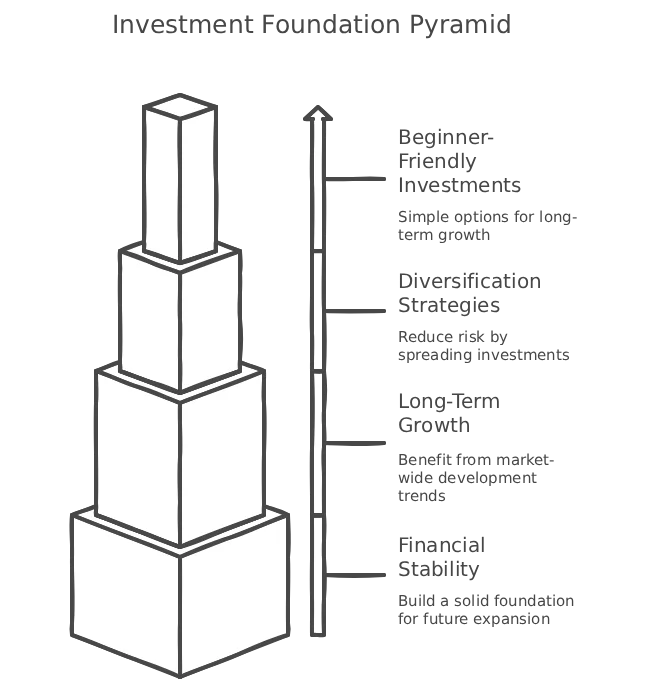
Instead of guessing what the boom will be further, you will benefit from the trends of comprehensive development throughout the market. Whether you want to invest a hand-off or a more active role, an option that fits your comfort level. And now, offer partial shares with platforms, even $ 10 can buy you into high-performing investments. So, where should a beginning actually start? The answer lies in the construction of its foundation with reliable options. The following five types of investment will simply help you do so.
Beginner-Friendly Investment Types:
- ETFs (Exchange-Traded Funds) – Instantly diversify by investing in bundles of stocks
- Index Funds – Track the performance of major indexes like the S&P 500 or Nasdaq
- Blue-Chip Stocks – Large, stable companies with strong histories and dividends
- Dividend Stocks – Generate recurring income while your assets grow
- Target-Date Funds – Automatically adjust risk as you approach a future goal
Each of these investments provides a different benefit, but they all share one thing: simplicity. For beginners, this is important. Instead of trying to do research on dozens of individual companies, ETFs and Index Funds give you exposure to many at once. This reduces your risk and saves time. On the other hand, blue-chip stock, perfect if you want to invest in brands you know and believe in, like Apple or Coca-Cola. They have better value during a recession and often pay dividends. Talking about dividends, those people can be reinstated to increase rapidly. It likes to get a bonus when you wait for the market to rise. If you are investing for retirement or any other long-term goal, the targets are great.
They do not need to do almost work and automatically become more conservative due to your timeline being short. Investment comes from real power, stability, and patience in the stock market – not the right time. By starting with these five types of investments, you are building a solid foundation. You can always expand to more advanced strategies later. But in the beginning, keeping things simple is often the clever step. These devices exist to help you grow safely and continuously, no matter how much you experience. The sooner you start, the more time you give your money. And how the money is actually made.
How to Invest Consistently Without Overthinking
One of the biggest challenges is ending every investment decision. When is the best time to buy? What will happen if the market crashes? Should I wait for a dip? These questions raise doubts – and often delay. But in fact, the investment in the success of the stock market does not depend on the right time. It depends on being consistent. This is why the chart or news is not the best approach to pay attention to the headlines – this is to create a habit. For example, to go to the gym or save money, small efforts over time give rise to big results. When you make investment automated, you remove the feeling from the process.
You stop reacting to fear and greed and start building real speed. And you do not need to invest hundreds every month to see the progress. Even $ 20, when invested continuously, can increase considerably over time. The key is to create a system that runs in the background of your life. Some you can set once and let the compound be quiet. So how do you do it from the beginning? It begins with a simple, repeated strategy.
Ways to Invest Consistently and Stress Less:
- Automate your contributions – Set a recurring monthly transfer to your investment account
- Use dollar-cost averaging – Invest the same amount regularly, no matter the market condition
- Start small – Begin with what you can afford; increase as your income grows
- Avoid checking daily – Focus on long-term goals instead of short-term noise
- Stick to a routine – Make investing a fixed part of your financial calendar
These actions may look basic, but they are incredibly powerful for a long time. Automating your investment means that you are always participating in the market, even during the recession. This is the place where the dollar-dollar average shines. When prices fall, you buy more shares; When they go up, you buy less. Over time, it helps reduce instability and reduces your average cost per share. It also eliminates the pressure of trying to estimate the “right” moment. Most investors do not fail because they choose the wrong stock, but because they are nervous, stop investing, or jump out and out of the market. The investing stock market approach that best works is simple: buy continuously and grab patiently.
You do not need to chase the next trend every day or monitor the market. Just keep contributing to your plan and rely on the process. As your income increases, increase your contribution gradually. And if your goals change, adjust your plan – not your entire portfolio. With stable investment habits, you will create a system that grows with you. Overthinking hesitates. But stability creates money. Choose another route.
Diversify: The Golden Rule of Smart Investing
One of the most important rules in the world of investment stock market is simple but powerful: do not put all your eggs in a basket. This is the place where diversification comes. This is not just a smart strategy – this is your first layer of protection against disadvantages. When you only invest in a company or sector, your entire portfolio increases and falls with it. It is risky. But when your money spreads in many industries and assets, one dip in one area can be balanced with profit in another. This makes your returns smooth and more reliable over time. Diversification helps you in the volatility of the weather market without panic. It keeps your feelings under investigation and keeps your portfolio more stable.

This also means that you do not depend on a large “winner” to reach your goals. Instead, you are building a broad, flexible foundation that increases gradually but continuously. Whether you are investing for retirement, a house, or passive income, diversification reduces the chances of major failures. This is a way of playing crime and defense at the same time. So, what does a well-diverse starting portfolio really look like?
Core Areas to Include in a Diversified Portfolio:
- Technology – Innovative companies that fuel growth and disruption
- Healthcare – Steady demand regardless of the economy
- Energy – Covers oil, gas, renewables, and infrastructure
- Finance – Banks, investment firms, and financial services
- International Stocks – Exposure to global markets and currencies
The inclusion of these five categories ensures that your portfolio is not tied to only one part of the economy. For example, technical stocks can offer high growth, but they can also be unstable. On the other hand, healthcare becomes more stable and necessary, even in a recession. By holding both, you balance the risk and return. Energy can grow with stock inflation, while financial rates can perform well during an increase in financial rates. International stocks provide access to an increase in emerging markets while protecting you from a domestic recession. This balance makes your investment stock market strategy more flexible. And as you increase more confidence, you can fix your allocation based on your goals, age, and risk tolerance.
Even if a sector underperforms in a given year, your overall performance can still be solid. The goal is not to avoid complete damage, but to ensure that no harm is caused, and as little pain. Smart diversification is the difference between gambling and investment. This is the calm force behind every successful long-term portfolio. So, before you add your next stock, ask: Is my money spread enough to survive in any season?
Investing Stock Market Mistakes to Avoid
Mistakes are part of learning, especially when you are starting your investment stock market. However, knowing what to see can save you from major failures. Many take early emotional decisions or follow the crowd – only to lose money and confidence. Before you start investing your money to work, it is so important to understand the most common misunderstanding. It is not about being correct. It is about getting ready. Some bad habits can slow down your progress or even eradicate the benefits earned by hard work. Good news? Most of these mistakes are easy to avoid with the right mentality and a little patience. When you focus on the strategy on the hyp, you stay grounded.
And when you invest with education instead of emotion, your decisions dramatically improve. In the world of investment, small misunderstandings can quickly turn into large regrets later. But now, by learning, you are equipping yourself for smart decisions and stable development. So, what are the most common errors to escape?
Costly Investing Mistakes Beginners Often Make:
- Following hype – Buying trending stocks without research leads to poor results
- Overtrading – Frequent buying and selling racks up unnecessary fees
- Ignoring diversification – Concentrated portfolios carry higher risk
- Timing the market – Trying to guess highs and lows usually backfires
- Not checking account fees – Hidden costs can quietly drain your returns
Avoiding this damage can dramatically improve your results in the long run. After promotion, it often means buying and selling less – especially when the nervousness is set. Without research, you are investing with your eyes closed. The overtrading may feel productive, but it chips in your capital over fees, taxes, and poor time. Ignoring diversification is like walking on a criterion without a safety trap – a mistake, and your portfolio suffers. Trying time in the market? It rarely works. Even professionals feel wrong. Instead, trust in dollar-negative average and long-term plan. And don’t forget to read the right print. Some brokers advertise “zero commissions”, but others charge high fees for services.
Combine those costs, especially over time. The best way to avoid these mistakes? Slow, do your research, and stick to your plan. The investment stock market is not about chasing winning – it is about stability, strategy, and living power. If you focus on your long-term goals and avoid these initial misunderstandings, you will be far ahead of most of the beginners before doing your first business. Want to dive deeper into smart money strategies? Visit our Investment section to explore tools, tips, and insights for building long-term wealth.
Ready to Start Your Investing Stock Market Journey?
You don’t require thousands of dollars or a finance degree to get started. You just need to start. In 2025, the passage of investment is clear and more accessible than ever. The obstacles are fewer. The equipment is smarter. And the information is correct on your fingers. If you want to create money, retire quickly, or simply prevent living salary for salary, your journey can start with only a few dollars and a decision. The beauty of the investment stock market is that it rewards patience and stability – not perfection. You do not have to know everything today. All you need is a desire to take the first step and live with it. Start small, stay stable, and focus on progress over time.
Use the equipment, resources and habits you have learned in this guide. Make a plan that you can really stick. Ignore the noise, rely on your process, and increase your knowledge as soon as you go. Remember, investment is not a sprint. This is a long game. But the sooner you start, the longer your money will have to work for you – and you have to get closer to financial freedom. then go ahead. Open that account. Submit your first. Choose your first ETF or index fund. You have done research. Now the time has come to take action. Because your future does not start someday – it starts from today.
Looking to boost your income while investing? Check out these simplest side hustles to make money online that fit perfectly alongside your financial goals. Even beginners can start earning with minimal effort.
FAQs About Investing in the Stock Market
1. Can I only invest in the stock market with $ 10?
Yes. Many platforms now offer partial shares, allowing you to start with $ 1 or $ 10.
2. Is the stock market safe in 2025?
While no investment is 100% safe, proper diversification and -long-term plan reduce risk.
3. What is the easiest way to start?
Use the user-friendly app like Sofi or BELECTING and invest in index funds.
4. How do I know which shares to buy?
Start with ETFs or use robo-commentaries that choose investments based on your goals.
5. Can I lose all my money?
Only if you invest irresponsibly. Various portfolios rarely lose everything.